What “at risk” should mean in a cohort program
A risk flag is only useful if everyone agrees what it means and what happens next. Why a plain, explainable definition beats a clever score.
In this article
A flag is a promise to act Link to “A flag is a promise to act”
Most programs lose learners quietly. Nobody decides to stop; they miss a session, then a week's reading, and the gap starts to feel too big to close. By the time anyone notices, the learner has already decided the program isn't for them.
Marking a learner "at risk" is supposed to interrupt that. But a flag on its own changes nothing. It's a promise that someone will look, understand what happened and reach out while coming back is still easy. If the flag is vague, or nobody owns the follow-up, it becomes one more badge on a dashboard.
A risk flag is only as good as the conversation it starts.
Explainable beats clever Link to “Explainable beats clever”
It's tempting to reach for a predictive score that blends dozens of signals. The trouble is that a number like "risk 78" doesn't tell the person reaching out what to say. A definition anyone can read aloud does.
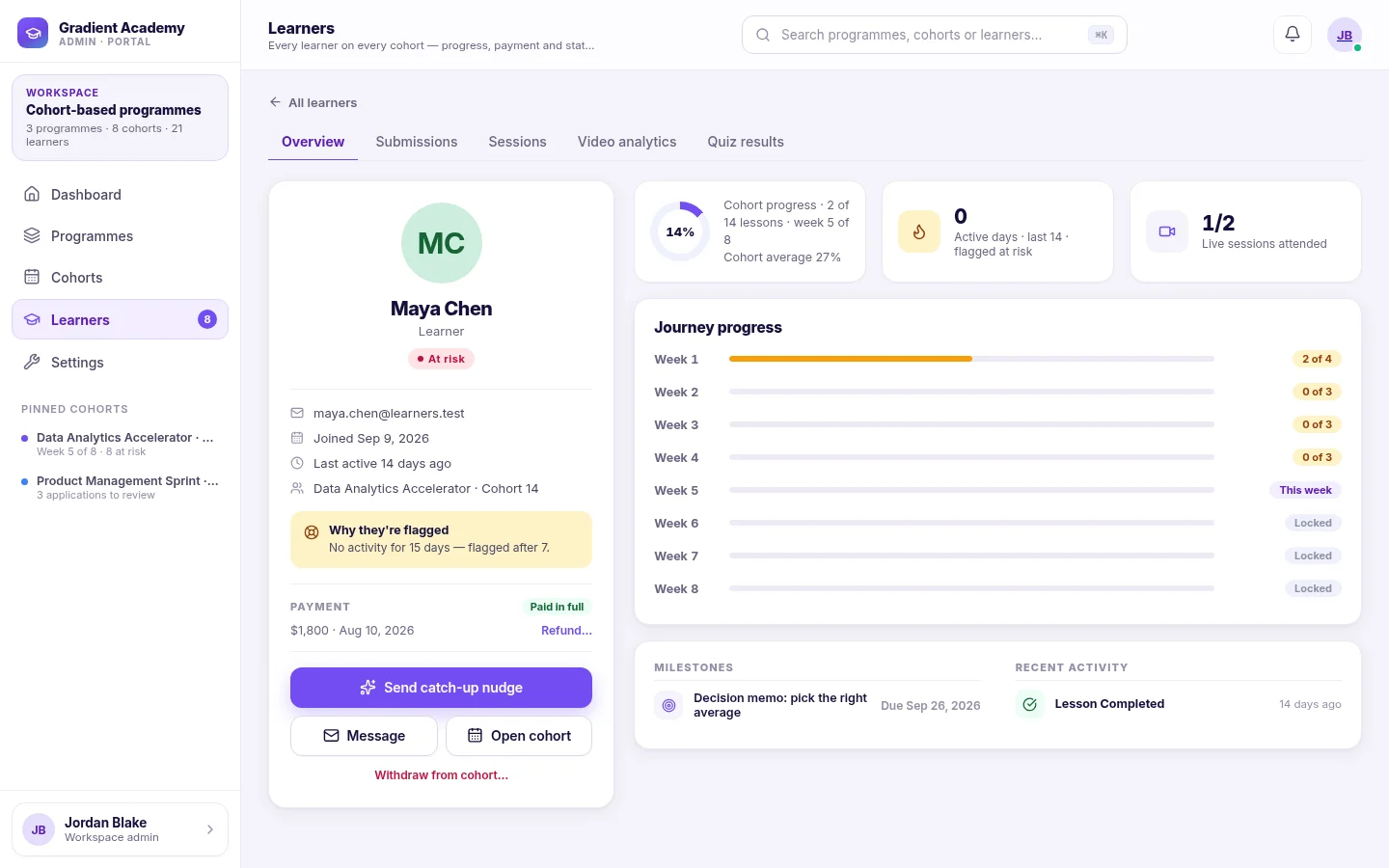
In Sublime LMS, a learner in a cohort is At risk for one of two reasons, and the reason is shown in words:
- They have had no activity for 7 days.
- Their progress is more than 25 points behind where the cohort's schedule says it should be.
So the flag reads "No activity for 15 days — flagged after 7", not a percentage. The person following up knows whether this is someone who has gone quiet or someone who is active but falling behind, and those are different conversations.
Related feature: Progress tracking
The flag should clear itself Link to “The flag should clear itself”
A risk status that has to be closed by hand goes stale. People forget, and the list fills with learners who recovered weeks ago. That erodes trust in the list itself.
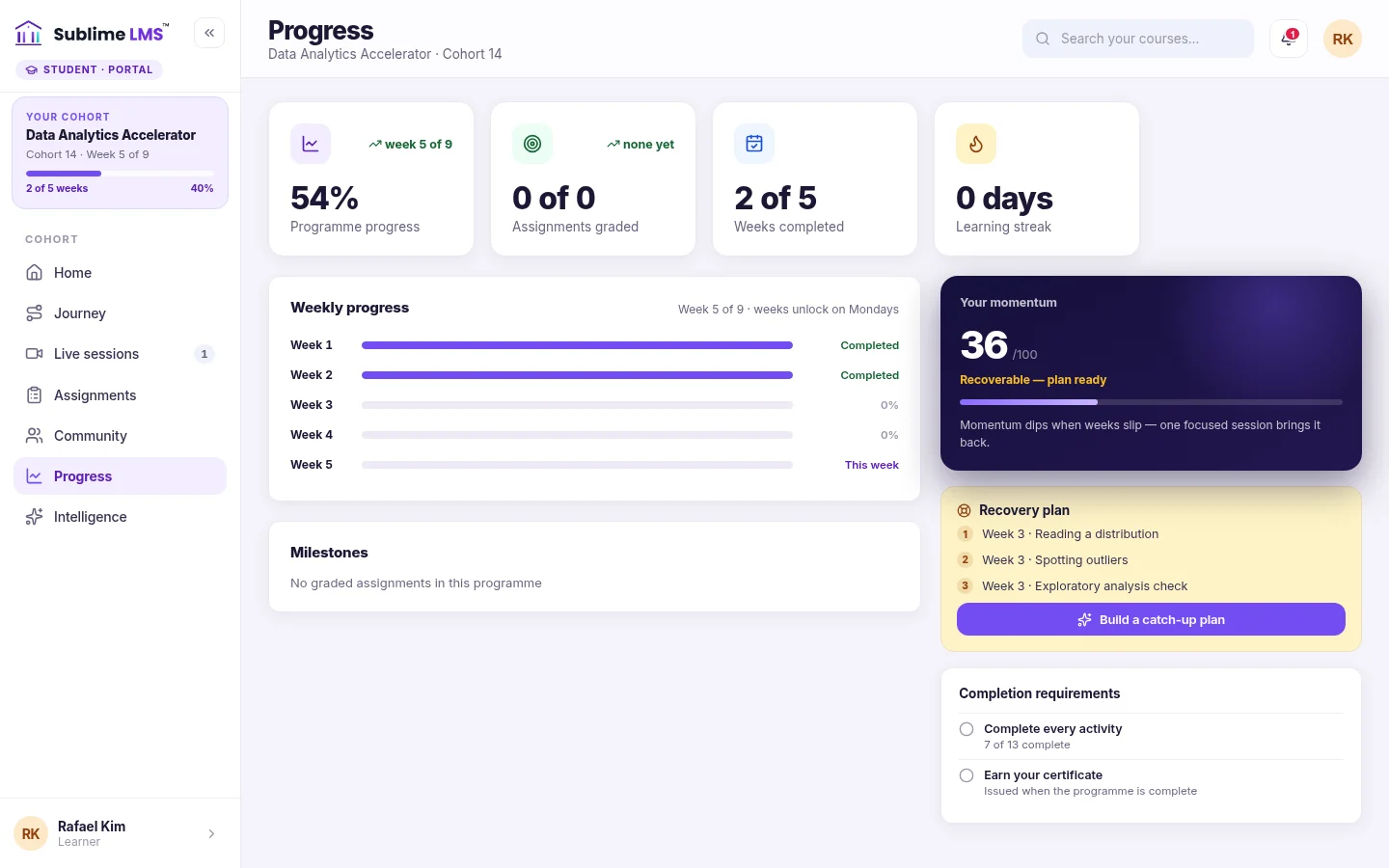
Sublime LMS works the status out from the learner's current activity each time it is shown. When they are active again and their progress catches up, they go back to On track without anyone touching it.
Decide who reaches out before the cohort starts Link to “Decide who reaches out before the cohort starts”
Flagging is automatic; reaching out shouldn't be. A message from a person who knows the program lands differently from an automated reminder, and it can name the one thing that will help this week.
In Sublime LMS, administrators send catch-up nudges by email, to one learner or to every at-risk learner in a cohort. Nothing is sent just because a learner is flagged. Instructors see the same statuses for the courses they teach, but don't send nudges themselves, so agree up front how names get from an instructor to whoever sends them.
Related feature: Recovery workflows
Related articles
-
Recovery beats prevention: make coming back small
You can't stop every learner from having a bad week. You can make the way back short enough that they take it. 2 min read -
The case for a shared schedule
Flexibility sounds kind. For many learners, a schedule they share with a group is what turns "someday" into "this week". 2 min read -
Designing a cohort learners want to show up for
Content gets learners to enroll. The week-to-week experience of the group is what keeps them coming back. 2 min read